


Biól. Jesús Ángel Barajas Fragoso
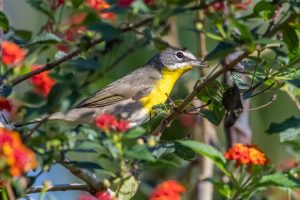
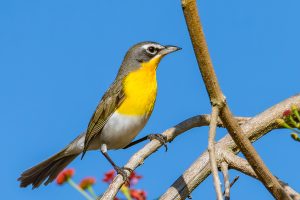
For a long time, Icteria virens, known as the Yellow-breasted Chat, was considered part of the Parulidae family, along with tree warblers, orioles, New World blackbirds, sparrows, and buntings. However, its unique behavior and characteristics puzzled ornithologists. Finally, in 2017, after years of taxonomic debate, it was given its own lineage: the Icteriidae family. This is a well-deserved recognition for a species that defied conventional categories.
Difficult to see and even more difficult to classify, this elusive bird prefers dense thickets, shrubby areas, and grassland edges. Its habitat, often described as impenetrable, is in decline due to the expansion of open areas driven by human activity. Thus, the closed, shrubby forests that were once its refuge are now increasingly fragmented, and these beautiful songbirds are becomming harder and harder for a birdwatcher to spot.
But there is a time of year when the chances of finding it increase. At the beginning of the breeding season, the male becomes more visible thanks to its surprising vocal repertoire, a mixture of whistles, rattles, growls, and cries that distinguish it from the undergrowth.
If that weren’t enough to intrigue us, the Cornell Lab of Ornithology shares that recent studies have revealed unexpected nocturnal behavior: both sexes make nighttime forays into non-breeding wooded habitats, dubbed “nightclubs” by researchers, where extra-pair encounters are suspected to occur. This is yet another detail that reinforces its reputation as an enigmatic bird.
It is not surprising that Audubon describes it as “its largest chickadee, and certainly the strangest, as it looks like a cross between a chickadee and a nightingale.” A bird that sings at night, hides during the day, and does not fit into any box… except the one it has built for itself.